

I’m not sure why it took me this long to explore the works of the mysterious Ancient Greek poetess Sappho. I recently picked up Penguin’s Little Black Book titled Come Close, a collection of her poetry, and was immediately taken somewhere deep and completely full of life.
As someone who has always focused on the writing of the poetry more than the reading of it, it has been such a pleasure reading ancient poetry that doesn’t feel like it needs to be deciphered in a class to be enjoyed. Sappho’s writing moves you with its immediacy, depth, and the sharpness of its observations.
Sappho’s words, where decipherable, are as unambiguous and clear as words possibly can be. At once sober and passionate, they tell, in an extinct language that has to be resurrected with each translation, of a heavenly power that, twenty-six centuries on, has lost none of its might: the sudden transformation, as wondrous as it is merciless, of a person into an object of desire, rendering you defenseless and causing you to leave your parents, spouse, and even children.
Judith Schalansky, What We Know of Sappho, The Paris Review, 2020.
Her words definitely blurred my sense of time a little: save for all the references to the Ancient mythical figures and Gods, the intensity of longing, the tenderness in her address, the sharp pang of jealousy or joy—what she brings to a piece really does feel like it could have been written yesterday. This, for one, has left me feeling so much nicer about my own troubles, because I’m reminded how timeless so many of our desires and thoughts and feelings are. It broadens my sense of belonging on this Earth.
For the uninitiated, Sappho is widely known for her prolific oeuvre of poetry, most of which has been lost to the ages, that covers a variety of themes, including love and desire, beauty, memory, family, and even religion. She was born on the island of Lesbos sometime around 630 BCE, and though very little is actually known of her life, her reputation was such that later writers called her the “Tenth Muse.” The very word lesbian traces back to her home island, and the term sapphic is drawn directly from her name—both reflecting the enduring association of her voice with the exploration of female love and desire. For those of you who want to dive in a little deeper, this 2020 article by Judith Schalansky in the Paris Review entitled ‘What We Know of Sappho’ is an absolutely great read.
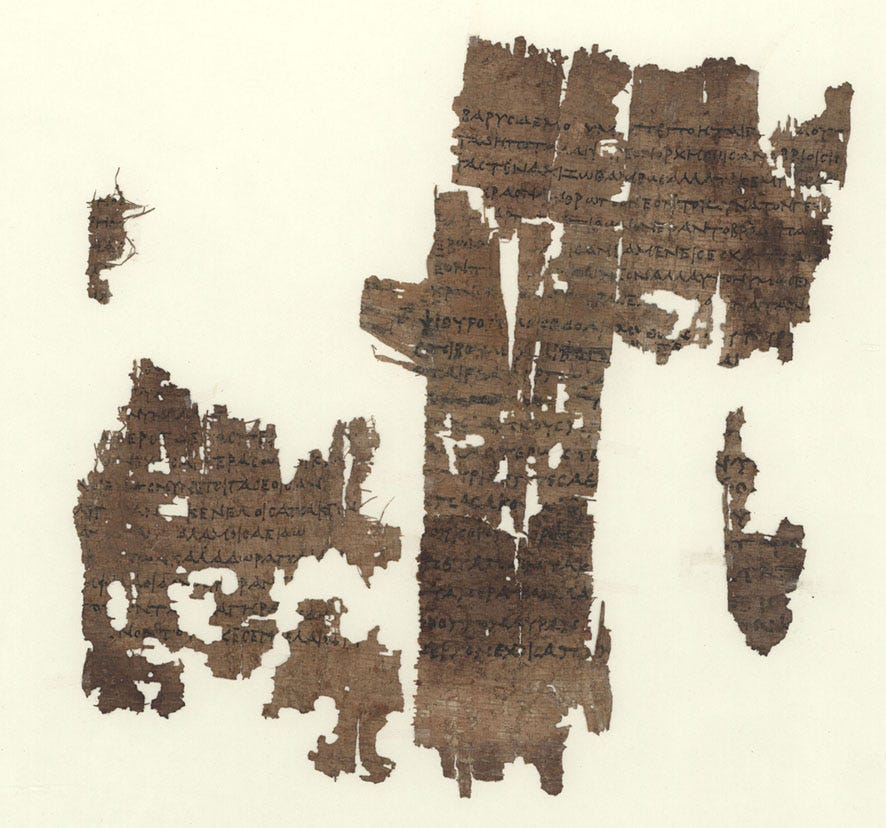

Clearly, what has survived of Sappho’s work has been enough to secure her a lasting place in world literature. But what is so plaguing is how little of her work has actually survived, which is a meagre 7% of her total collection as per some calculations. Many of her poems that are accessible to us today are incomplete, some with obvious gaps, and others saved by pauses, elipses, and bracketed emptiness. That’s why I am in such awe of the work of scholars in unearthing, verifying, translating, then piecing together what little they could save and decipher. Whether or not her poems survive as they were originally written, there is still a real sense of completeness in everything I’ve read so far. I might even venture to say that there is something really beautiful to the fragmented structures of her surviving work, not inspite of what has been lost, but maybe because of it.
“The fragment, we know, is the infinite promise of Romanticism, the enduringly potent ideal of the modern age, and poetry, more than any other literary form, has come to be associated with the pregnant void, the blank space that breeds conjecture. The dots, like phantom limbs, seem intertwined with the words, testify to a lost whole. Intact, Sappho’s poems would be as alien to us as the once gaudily painted classical sculptures.”
Judith Schalansky, What We Know of Sappho, The Paris Review, 2020.
Another thing I have come to appreciate about Sappho is that she is one of the pioneers of ‘lyric poetry’, which was not epic tales of heroes and wars, but private, intimate reflections of lived experiences meant to be set to the sound of the lyre or performed as a chorus. Even her verse form, the Sapphic stanza, has carried her name through centuries, influencing poets ancient and new alike, Horace for example, or Audre Lorde. But by writing so candidly about the personal, she gave voice to the kinds of fleeting but overwhelming moments that shape a life, and in doing so, carved out a space in literature for the personal as a form of the eternal.
And perhaps this is why her work seems to resonate with me so strongly. It validates the inner life, showing that the tremors of experience, like longing, joy, and despair, are not small or trivial, but the very material of poetry itself. It makes me think about how much of what we call literature begins in these private truths, spoken aloud, preserved if we are lucky.
This tryst with Sappho’s grounding poetry has definitely got me thinking about the randomness of what gets preserved and what doesn’t, and about so much that we may never know about the Sapphos of the world. I cannot help but think how fragile and precious human expression can be. And at the same time, how miraculous, that across 2,600 years, words written in another tongue, in another world, can still reach me here and now, and make me feel less alone in being human.
And though only about 600 lines of poetry have survived, I take comfort in the fact that I have much of her still left to read, and several translations of these same lines, and that delights me.